 Kristina ;D
Working With a Freelancer: Access, Approvals and Handover
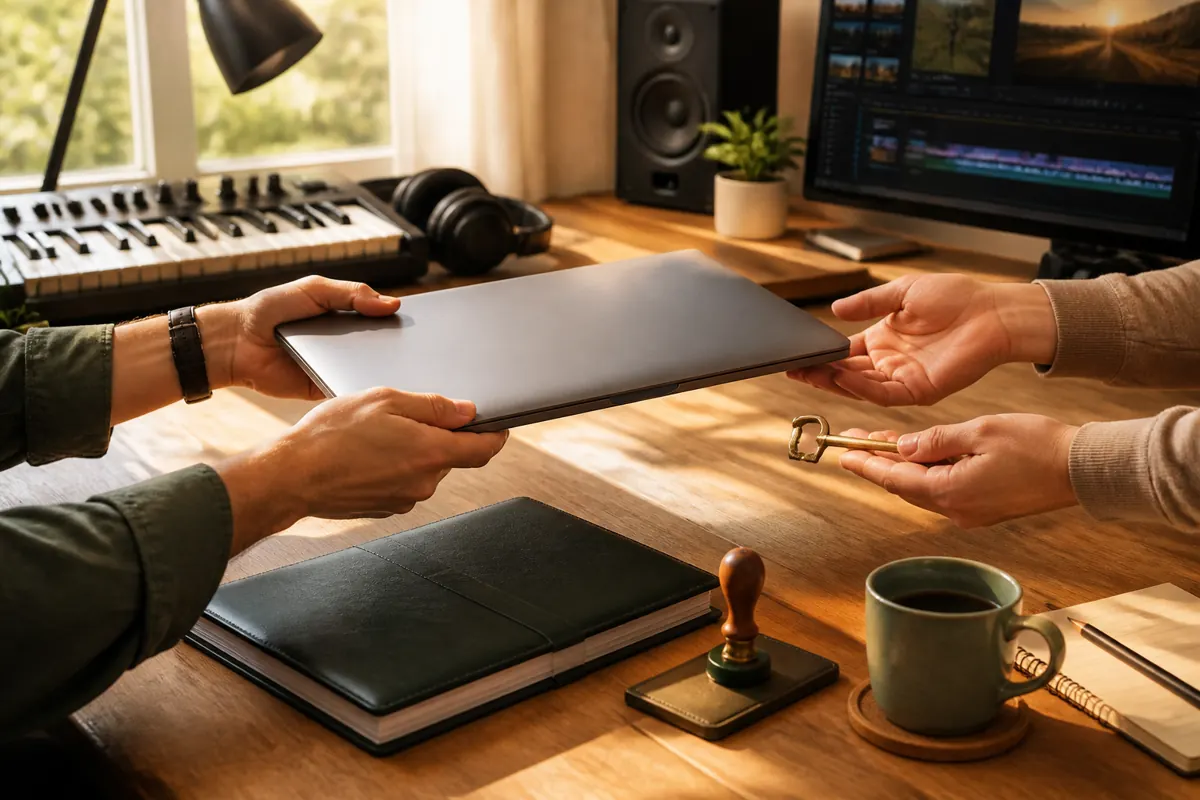
The safest way to work with a freelancer is to agree on four things before the first payment: what exactly will be delivered, who owns the result, which accounts stay in your name and how you will accept the work. Most problems with freelancers come from missing one of these, not from a lack of talent.
What you are really buying
You are not buying hours. You are buying a result you can use: a working site, a finished video, a set of tracks you can publish. Describe the result in plain words and, if possible, in a list of deliverables. "A one-page site with four sections, a contact form and a mobile version, delivered with all source files" is clear. "Help with my website" is not.
How to choose someone
A portfolio shows what a person can do, but it does not show how they work with clients. Two extra steps help.
- Look for relevant work. Choose someone who has already made something similar to what you need, not just something impressive.
- Start with a small paid task. A short test project reveals communication, speed and attention to detail far better than a conversation does. It also gives you something real to compare between candidates.
Pay attention to how the person asks questions. Good freelancers ask about your goal and audience before they talk about tools. If you have a written plan, your first message becomes much easier. See what to put in a website brief.
Rights to the materials
Agree in writing who owns the finished work. If it is not stated, you may end up with a design you cannot change or a track you cannot use in a new project. Ask three questions: can I modify the work, can I use it commercially, and are there parts, such as stock images, fonts or samples, that have their own license terms? Copyright and licensing rules differ by country, so for anything important ask a qualified professional.
This matters most with images. A picture found online and used without permission can lead to a demand for payment later. A safer habit is to use your own material, licensed material with a clear receipt, or images you have the right to use. See AI-generated images for your website for another option and its limits.
Accounts and access
Keep anything valuable in your own name. The domain, the hosting account, the analytics, the social profiles and the cloud storage should all belong to you, and the freelancer should be invited as a user. That way, if the relationship ends, you keep everything and only remove their access. The reverse, where the freelancer owns the accounts and you ask for access, is a common source of lost websites.
Share passwords through a password manager rather than by message, and remove access when the work is finished.
Accepting the work
Check the result, not the report. Open the site on a phone and a computer, click every button, submit the form and see where the message arrives, read the text aloud, and test the loading speed. For video, watch it on the device where your audience will see it. For music, listen on headphones and speakers.
| Check | What to look for |
|---|---|
| Deliverables | Everything from the agreed list is present |
| Quality | It works on real devices, not only in a preview |
| Files | Source files, fonts and assets are handed over |
| Access | You can log in to every account and the freelancer's access can be removed |
| Documentation | A short note on how to edit and where things are stored |
Paying in stages
Rather than paying everything at the start or everything at the end, divide the payment into stages tied to visible results, for example after the design is approved and after the delivery. Both sides feel safer. Do not skip a written agreement even for a small job. A short email that lists the deliverables, the price, the number of revisions and the deadline helps prevent many misunderstandings. For large projects, a qualified professional can review a formal contract.
When you do not need a freelancer
If the task is small and you have the time, a builder or a simple tool may be enough. A freelancer makes sense when the result matters to your business, when the work needs skill you do not have or when your time is worth more than the cost. If you are still comparing options, website builder or custom website explains the main trade-off.
A short example of a clear agreement
A written agreement does not have to be formal. A message that both sides confirm is often enough for a small project. It can say: the deliverables are a four-section site with a contact form, the price is a single total, the payment is split into two parts, two rounds of changes are included, the domain and hosting stay in the client's name, and the final files are handed over at the end. Anything beyond this list is discussed and priced separately. Writing it down takes little time and often saves a lot of confusion.
Communication habits that keep projects on track
- Give feedback in one message. Collect your comments and send them together, with the most important point first.
- Be specific. "The header feels heavy" is a starting point; "the header takes a third of the phone screen" is something a freelancer can fix.
- Answer questions quickly. Many delays come from the client, not the freelancer, because text, images or approvals arrive late.
- Agree on one channel. Choose email or a messaging app and keep decisions in one place.
FAQ
Should I pay a freelancer in advance?
A small deposit is common, but paying in stages tied to results protects both sides better than paying everything up front.
What should a freelancer agreement include?
The list of deliverables, the price, the deadline, the number of revision rounds, who owns the result and how the work is accepted.
How do I avoid getting locked in?
Keep the domain, hosting and accounts in your own name and ask for all source files at delivery.
What if the result is not what I expected?
Compare it with the written deliverables. Clear descriptions at the start make it easier to point to what is missing and ask for a fix.
Can I use a freelancer for ongoing work?
Yes. For regular updates, agree on a monthly scope or an hourly limit so that both sides know what to expect.